
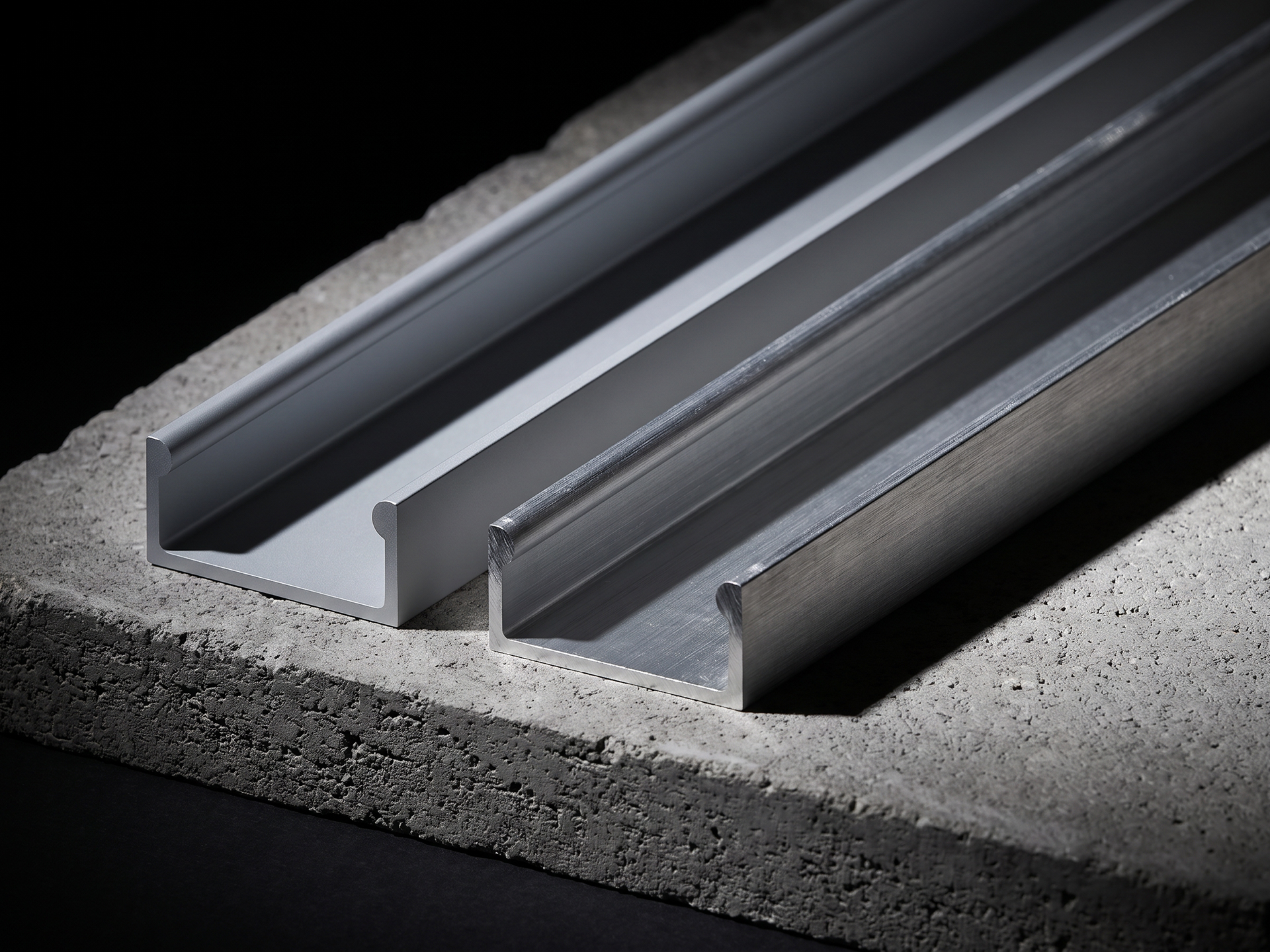
“Engineering of Light” – a TECH Light series on how LED profiles are made
A question we hear more and more often
In the previous article we described what the anodic layer is and what you choose within it: thickness, colour, sealing. We left one question open – the one heard today in many sales conversations: is anodising needed at all?
It comes up most often with profiles for plasterboard. The profile is recessed into the board and plastered over; all you see from the ceiling or wall is a line of light – so why pay extra for finishing a surface that nobody will see. This is sometimes followed by the claim that mill-finish aluminium dissipates heat better, because it has no oxide layer on it.
We already flagged the subject in the first article of the series, at the anodising stage. Now we are checking that argument point by point – including the claim about heat, which we did not address back then.
Where the mill-finish profile on the market comes from
The mill-finish profile did not appear in product ranges because it turned out to be better. It appeared because anodising is a costly production stage today: an electrolytic bath under voltage, energy, chemicals, sealing, inspection.
The simplest way to lower the price of a profile is to skip that stage. Some manufacturers did exactly that, and along with the profile without an anodic layer came arguments that the layer is unnecessary – most convincing precisely where the profile disappears under the plaster anyway.
We understand the pricing logic. We disagree with the conclusion. A mill-finish profile wins on price on the day of purchase – on the points that matter in a LED installation, it either loses or draws.
Heat conduction – a difference you will not see in an installation
Aluminium oxide does conduct heat worse than pure aluminium. That is a material fact.
It is a matter of proportion. The anodic layer is measured in micrometres, the wall of the profile in millimetres. And along the whole path of the heat from the diode to the surroundings, the greatest resistance is neither the metal nor the oxide, but the release of heat into the air itself. Against that background the anodic layer is a negligible fraction. The difference can be measured in a laboratory – it cannot be noticed in an installation.
Heat dissipation – here the anodic layer helps rather than hinders
A profile releases heat in two ways: into the air around it and through infrared radiation. The second route is governed by the emissivity of the surface – and that depends on the finish.
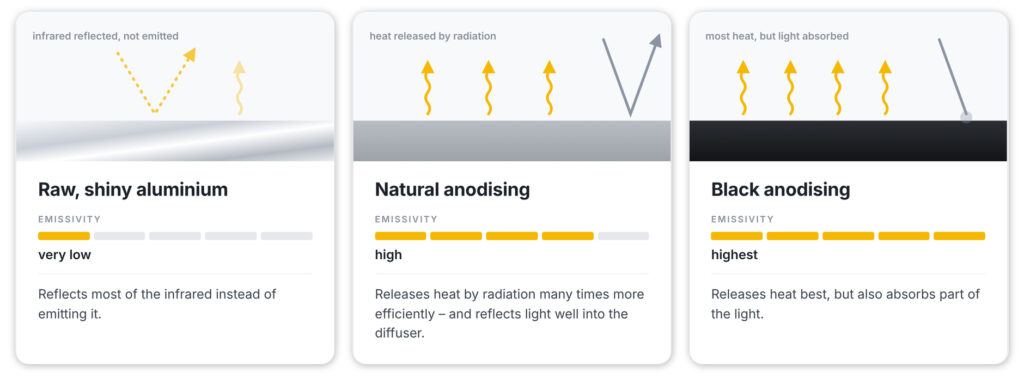
In passive cooling – that is, in practically every LED profile – the anodic layer works in favour of cooling, not against it. The claim that mill-finish aluminium cools better therefore turns the matter on its head.
Except that in a LED profile thermal performance and optics pull in opposite directions. A black anodic layer releases heat best, but the inside of the profile then absorbs part of the light instead of reflecting it into the cover. A natural anodic layer reflects more light at the cost of slightly lower emissivity. There is no single right choice here – there is a trade-off that has to be settled at the design stage.
In a profile for plasterboard, thermal headroom matters especially. A plastered-over profile sits in a gypsum board, which conducts heat poorly, so the heat from the strip has fewer escape routes than in a surface-mounted profile. All the more reason why everything that helps release it counts – including the surface of the channel beneath the cover.
A mill-finish profile has an anodic layer too. Just an uncontrolled one
This is the fact that is easiest to forget in this discussion.
Aluminium reacts with oxygen from day one. On a mill-finish profile an uneven, matt oxide layer forms over time – except that nobody controls it: neither its thickness nor its appearance. Along the way, the mill-finish surface is easier to scratch during installation and picks up fingerprints and dirt that you will not remove later.
With a profile for plasterboard there are also the finishing works: damp jointing compound, dust, water. The anodic layer separates the metal from its surroundings – a mill-finish profile is in direct contact with them.
Anodising does not add anything foreign to the aluminium. It replaces a random process with a controlled one.
The difference in brief
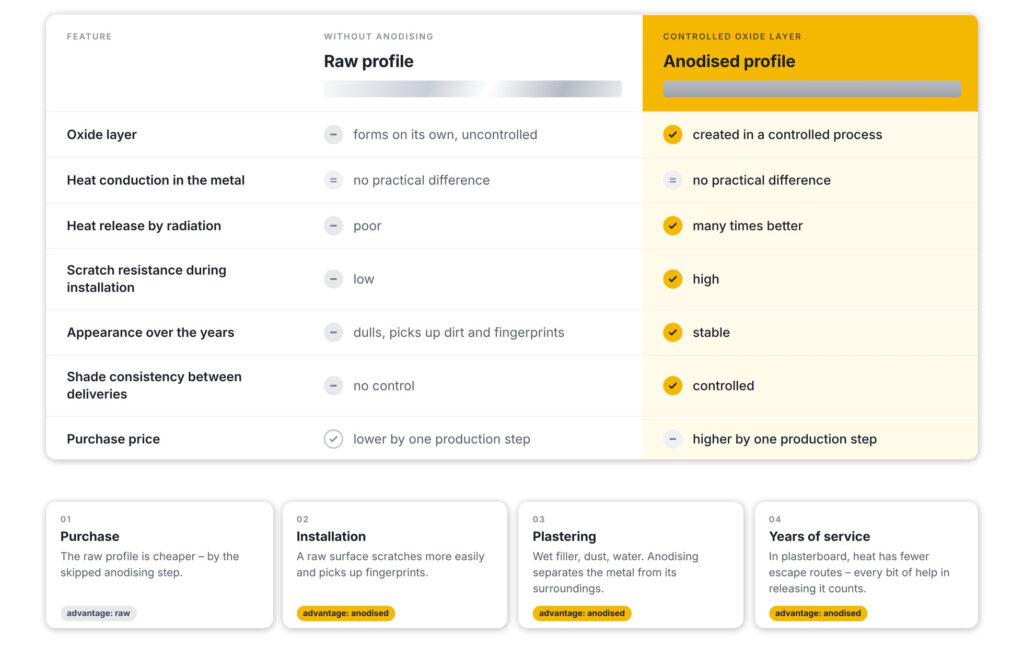
What you are really saving on
The saving on a mill-finish profile is real, but it concerns one moment: the purchase. A profile is meant to work for longer than a renovation lasts – and on that scale the calculation looks different.
By giving up the anodic layer, you save on the stage that protects the surface during installation and in the build-in, helps release heat throughout the life of the installation and provides a predictable shade in the next delivery.
With a profile for plasterboard the calculation is even simpler. You will not replace a plastered-over profile without cutting the board open and plastering it again. The choice of a profile for a build-in is a decision you cannot take back. The argument “you cannot see it anyway” stops working on the day someone has to return to that installation. That is why a mill-finish profile in a LED installation is an apparent saving, not a good solution.
Why we write about this as a manufacturer
We know the simplest way to a lower profile price just as well as everyone else. We do not make it our standard, because the anodic layer is part of the profile: it protects its surface, helps release heat and maintains its appearance for years.
For the record: the TECH Light range does include individual models available in a mill-finish version as well – for customers who deliberately ask for it. They are not our standard and we do not recommend them. If you ask us which profile to choose, the answer is: the anodised one.
The material and dimensions of our profiles have remained unchanged for years. We treat the surface finish the same way: it is part of the profile, not an item to be struck off the cost estimate.
How to see the difference on a sample
- Take a length of a mill-finish and an anodised profile. Drag the edge of a spanner across both – you will see the difference in scratch resistance immediately.
- Touch both lengths with your fingers. On mill-finish aluminium the prints show far more clearly.
- With a repeat order, compare profiles from two different batches under the same light.
If your project has special requirements – colour, work in humidity, a plasterboard build-in – your TECH Light account manager will help you choose the right profile before it reaches the site.
This is where the path of the profile itself ends
Over four articles we have described the profile from four sides: how it is made, what it is for, what covers it and what that layer actually changes.
But a profile never works alone. Every time we wrote about one parameter, others appeared: wall thickness was tied to heat dissipation, the depth of the profile to the visibility of the LED points, the colour of the anodic layer to the amount of light reflected into the cover. In the next article of the “Engineering of Light” series we will map out these connections: strip, profile, cover and build-in – what is linked to what, and what you cannot have at the same time.
The choice between a mill-finish and an anodised profile turned out to be simple. The hardest decisions in a project, however, are not the ones where one solution is simply better than another – but the ones where one is bought at the cost of the other.
TECH Light – Premium solutions at Your fingertips.


