
“Engineering of Light” – a TECH Light series on how LED profiles are
Introduction
It’s easy to see a LED profile as a decorative element – an aluminium frame that hides the strip and diffuses the light nicely. That’s only half the truth. A profile has two tasks that aren’t visible at first glance: it draws heat away from the LED strip, and shapes the light coming out of it.
In the previous article we showed how a profile is made – stage by stage. We promised that in the next one we’d answer what it is actually for. Here’s the answer: a profile is the heat sink and the optics of an LED strip in one. And how well it performs both roles determines how long, how consistently and how well your installation shines.
Heat is the quiet enemy of light
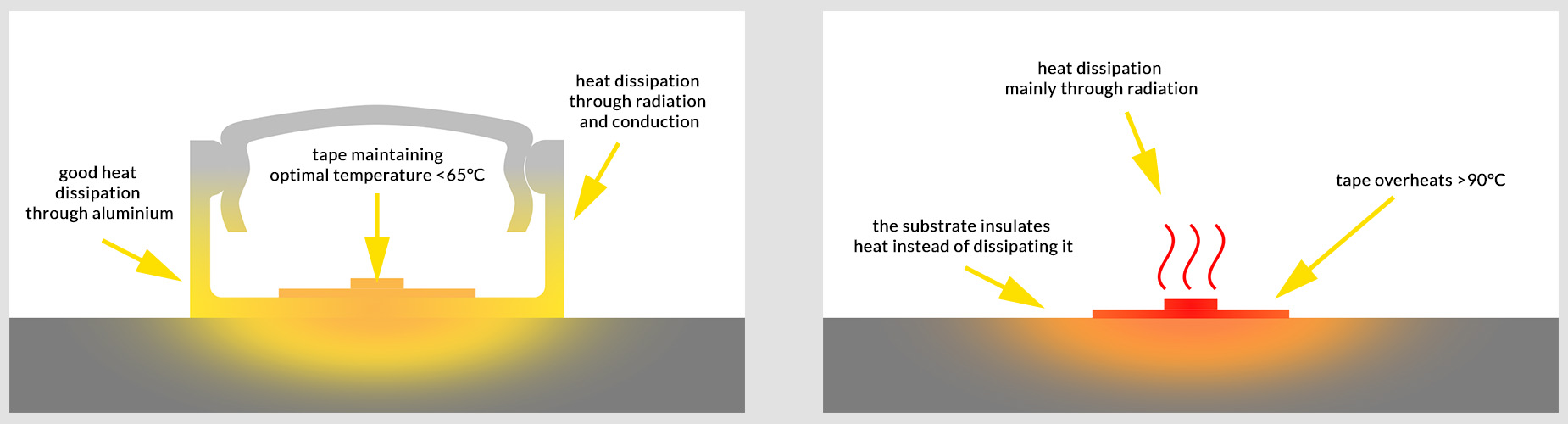
A LED doesn’t “burn out” like a bulb. It ages – slowly losing brightness and shifting in colour. The pace of that ageing depends largely on one factor: operating temperature. The hotter the strip runs, the faster the diodes lose light output and the more the colour starts to drift.
This is where the profile and its properties come in. Aluminium takes heat from the strip, spreads it along the full length and releases it outwards. A profile that performs this role well keeps the diodes at a lower temperature – and a lower temperature means slower ageing of the lighting installation and light that looks the same years later as it did on day one. A profile doesn’t shine, but it decides how long the strip installed in it will.
Alloy and geometry – where cooling comes from
The ability to draw heat away is no accident. It starts with the aluminium alloy: its composition and quality determine thermal conductivity – how efficiently heat “escapes” from the strip into the material.
The second factor is geometry, which is born in the die and during extrusion (we described those stages in the previous article). The thickness and distribution of the walls are at once the mass that absorbs heat and the surface that releases it. That’s why the more powerful the strip, the more the choice of profile matters – a profile that is too slight simply won’t keep up with cooling a powerful strip. Conversely, with a weaker strip an oversized profile means unnecessary cost and weight – a lighter profile is perfectly sufficient to carry away a small amount of heat. The shape of a profile isn’t just aesthetics – it is its properly matched capacity to take heat away.
Hardness and stability – why ageing and temperature control matter
A profile has to work for years, often inside a build-in that isn’t easy to reach. So what counts isn’t only how it looks at the start, but whether it holds its properties over the long term. That comes down to temperature control in the process, and especially to artificial ageing, which gives the aluminium its target hardness and strength – while preserving good thermal conductivity.
The effect is visible in practice: a harder profile is more difficult to dent and scratch during installation, holds its geometry better and doesn’t deform under its own internal stresses. A properly aged profile stays exactly as it left production – which is precisely what you expect from a component meant to light for years.
A profile shapes light, it doesn’t just hide it
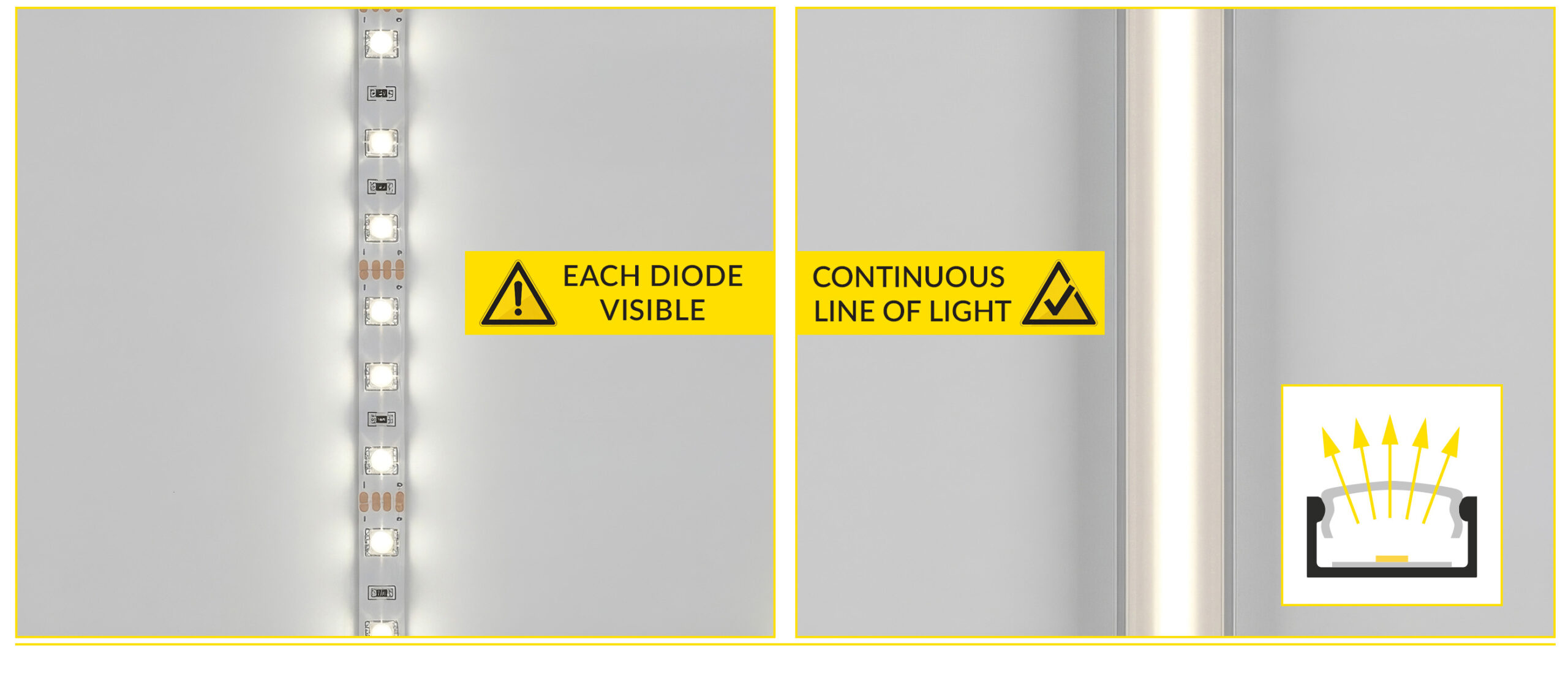
Cooling is one job. The second is visible to the naked eye – though few people associate it with the profile. A bare LED strip shines as a row of distinct points: you can see the individual diodes, the light is uneven and glaring at an angle. It is only the profile with a cover that turns those points into a uniform line.
The profile sets the strip at the right depth, on an even axis and at the right distance from the cover – and the cover diffuses the light. Together they determine what you actually see on a wall or in a piece of furniture: a soft, continuous line of light, or a row of visible “dots”. The geometry of the profile also gives the light its direction: a surface-mounted profile lights differently from a recessed or corner one. The angle and character of the light begin in the profile. The cover completes the effect, toning down contrast and smoothing the light image, but it is the geometry of the profile that sets the foundation.
Why we write about this as a manufacturer?
Cooling, hardness, durability, the way a profile guides light – these are not qualities a profile “has by nature”. They are the sum of decisions made during production phase: the alloy determines thermal conductivity, the geometry from the die determines cooling and how the profile guides light, temperature control and ageing determine hardness and durability, and the surface finish determines protection over the years. As a manufacturer, TECH Light sets these properties – deliberately and repeatably. The material and dimensions of our profiles have remained unchanged for years – precisely so that a profile performs its role the same way in every installation that follows. And if you’re not sure which profile will best carry heat away from your strip and guide its light, your TL account manager will advise you – from matching the profile to power and application through to full specification.
What this means in practice
A LED profile isn’t a housing added “at the end”. It is the component that decides how long, how brightly and how well the whole installation shines. Appearance you see immediately. Performance – only after years. And both are settled at the production stage.
There is one more layer – literally. Before a profile reaches you, its surface is covered by a thin, hard layer of oxide: anodising. It is what protects the aluminium against corrosion and scratching, and what makes a profile look and perform the same after years as it did at the start. A layer measured in micrometres, yet it determines a surprising number of things – which is why we’re dedicating the whole third article of the “Engineering of Light” series to this matter.
TECH Light – Premium solutions at Your fingertips.
[Order samples →] | [Contact your TL account manager →]


