
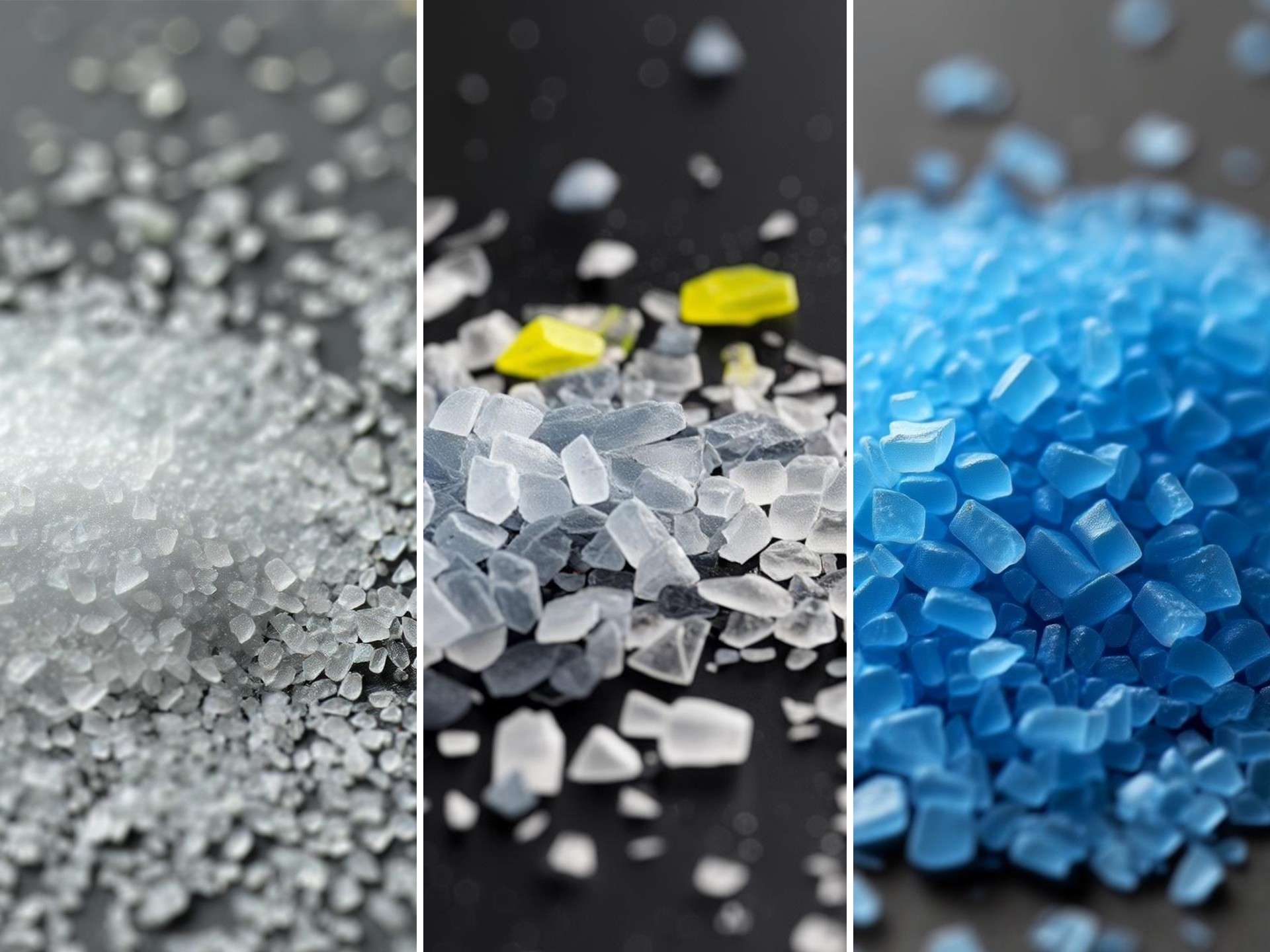
Why the abbreviation “polycarbonate” does not tell the whole truth about LED covers
In the linear lighting industry, the term “polycarbonate” is often treated as sufficient information about the material of an LED cover. When the abbreviation “PC” appears in a specification, it is frequently assumed that the material’s properties are obvious and comparable to other solutions based on the same polymer.
In practice, this is one of the most misleading simplifications.
Polycarbonate is not a homogeneous material, and differences between its variants have a real impact on the durability and long-term behavior of LED covers.
Polycarbonate as a group of materials, not a single product
Polycarbonate belongs to the group of amorphous engineering plastics, valued for high mechanical strength, thermal stability, and good optical properties. These characteristics make PC widely used in technical applications — including LED lighting.
At the same time, the term “polycarbonate” covers various material blends that may differ significantly from one another. For the end user, an LED cover made of PC may look identical on the day of installation, yet its behavior after months or years of operation can be completely different.
The way a cover performs in an LED system is influenced by, among others:
-
-
- the composition of the polycarbonate blend,
- the presence and quality of UV stabilization,
- thickness and uniformity,
- consistency of material parameters.
-
To właśnie te czynniki decydują o tym, czy osłonka zachowa swoje właściwości mechaniczne i optyczne w długim okresie użytkowania.

These factors determine whether the cover retains its mechanical and optical properties over long-term use.
Standard market polycarbonate – good properties, but not without limitations
Standard market polycarbonate offers very good initial parameters: high impact resistance, good light transmission, and a wide operating temperature range. In many applications, it is a fully sufficient material.
Standard market polycarbonate offers very good initial parameters: high impact resistance, good light transmission, and a wide operating temperature range. In many applications, it is a fully sufficient material.
However, LED systems operating for long periods at elevated temperatures impose additional requirements. An LED cover:
-
-
- is located directly above the light source,
- is subjected to heating and cooling cycles,
- must retain elasticity and dimensional stability for years.
-
Under such conditions, even small material differences can lead to noticeable changes in cover behavior — loss of flexibility, changes in optical properties, or fitting issues with the profile.
TECH Light polycarbonate – material selected for real LED operating conditions
Design and operational experience at TECH Light led to the conclusion that using polycarbonate as a base material alone does not guarantee predictable results over long-term use.
Therefore, TECH Light covers use polycarbonate that is specifically selected and refined for the actual operating conditions of LED systems, rather than a standard market blend. Key aspects include:
-
-
- long-term stability of material parameters,
- resistance to prolonged thermal exposure,
- retention of elasticity and shape,
- repeatable quality in serial production.
-
In practice, this means we are not talking about “polycarbonate” in general, but about TECH Light polycarbonate — a material designed for long-term operation of LED systems.
Thickness and uniformity – underestimated but critical parameters
One of the most frequently overlooked aspects in evaluating LED covers is thickness and uniformity. These largely determine:
-
-
- mechanical resistance of the cover,
- the way light is diffused,
- resistance to thermal deformation,
- elasticity during installation and removal.
-
Two polycarbonate covers may have completely different functional properties, even if they look identical at first glance. These differences become apparent only during operation, when the material works under real LED system conditions.
UV stabilization – invisible, yet decisive for durability
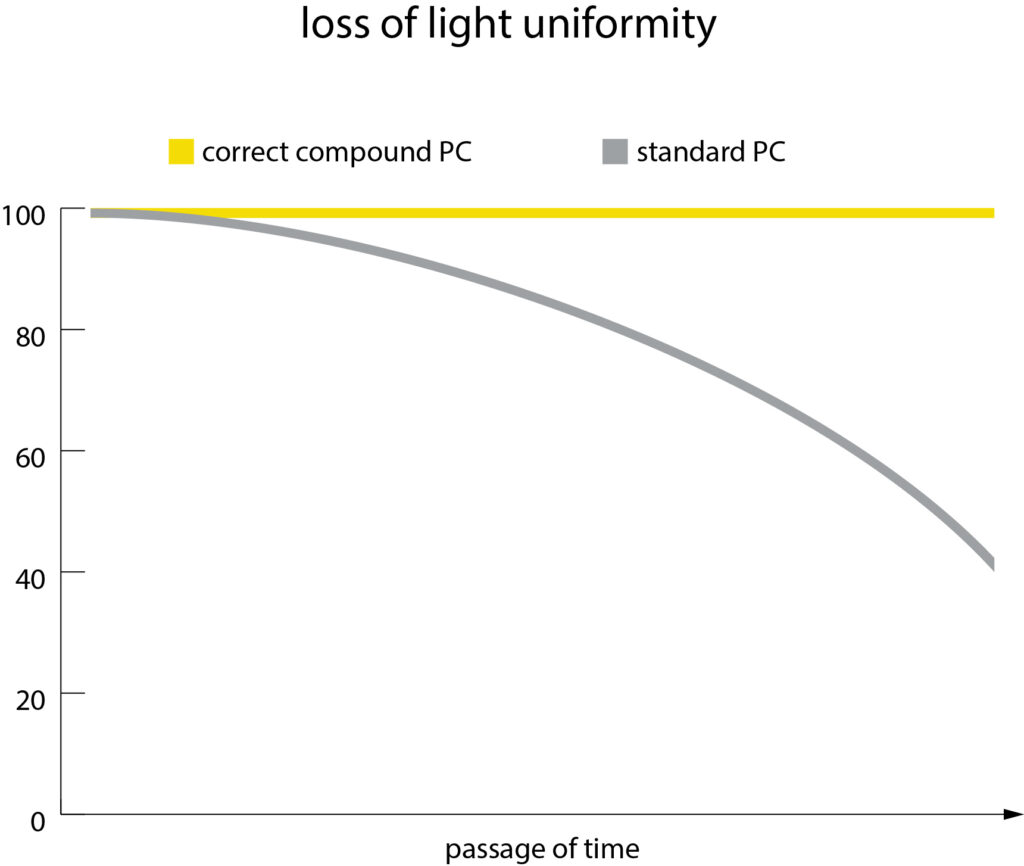
Polycarbonate is not inherently resistant to UV radiation. Without proper stabilization, prolonged exposure to light can lead to gradual material degradation and changes in optical properties.
The use of UV stabilization makes it possible to:
-
-
- maintain the cover’s appearance over time,
- preserve light uniformity,
- limit material aging processes.
-
This is one of the elements that in practice distinguishes covers designed for long-term operation from budget solutions whose parameters deteriorate with time.
Why “PC ≠ PC” matters in practical design
On the day of installation, differences between LED covers made from various polycarbonate variants are usually invisible. The real differences appear only during operation, when the system
-
-
- operates at elevated temperatures,
- undergoes hundreds of thermal cycles,
- must maintain parameter stability for many years.
-
Precisely here it becomes clear that:
-
-
- the abbreviation “PC” is not sufficient to assess solution quality,
- material and design details are critical,
- predictability of cover behavior is just as important as its initial appearance.
-
Summary
Polycarbonate is one of the best engineering materials used in LED profile covers, but not every polycarbonate delivers the same end result. Differences in blend composition, UV stabilization, wall thickness, and control of material parameters mean that covers can behave very differently over long-term use.
Therefore, in professional LED systems, the key question should not only be:
“is the cover made of polycarbonate?”
Much more important is the question:
“which polycarbonate was used, and for which operating conditions was it selected?”


