
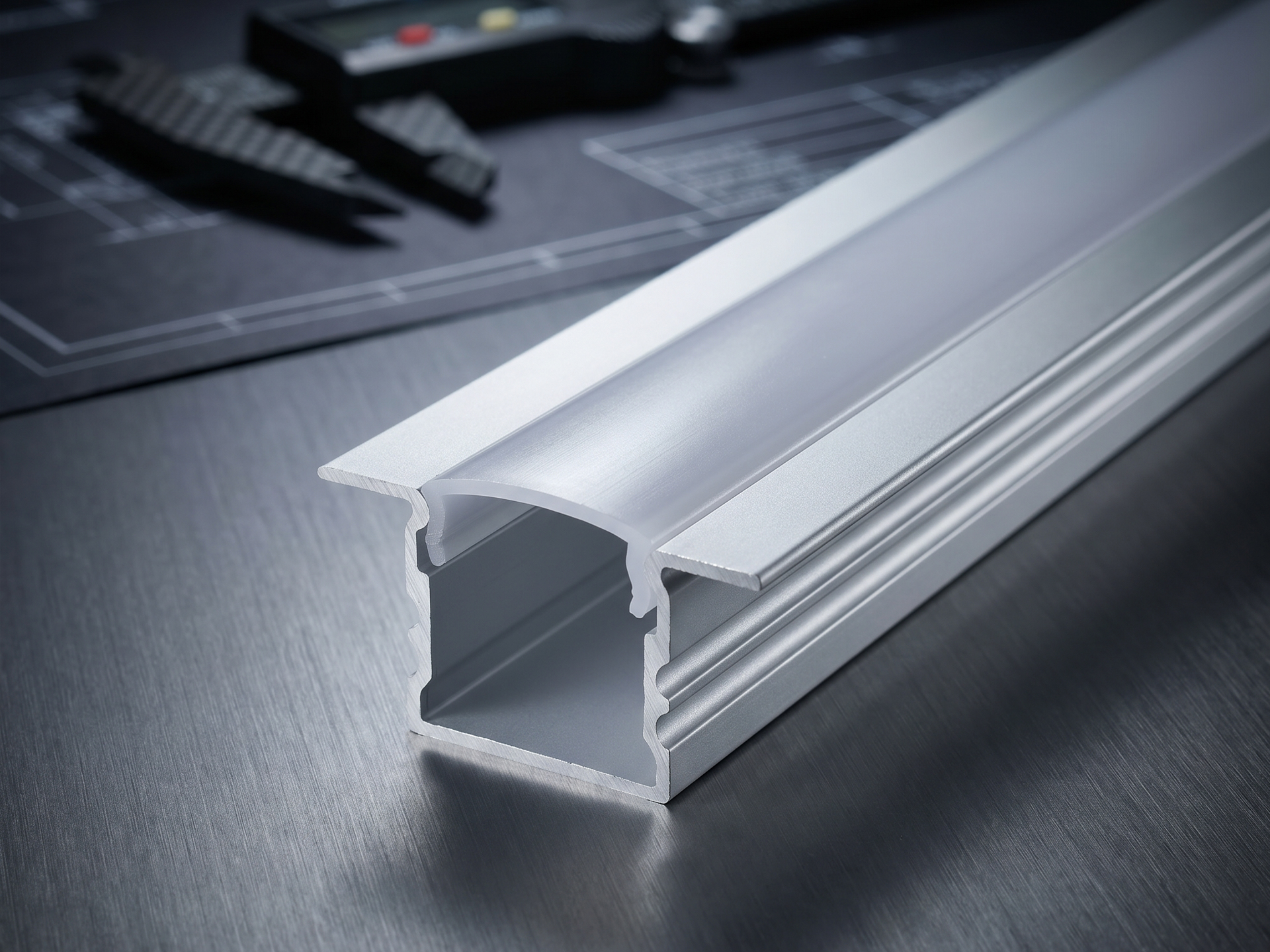
How the construction of an LED cover affects its durability and performance
In previous articles, we showed how the cover material and its type influence the light effect and system predictability. We also discussed the importance of compatibility with the profile.
At this stage, a question arises: why can two solutions that appear identical in terms of material and type behave differently over time?
The answer lies in the construction details. These determine whether the cover retains its properties during use, maintains stable seating in the profile, and provides a consistent light effect along the entire length of the installation.
It is worth emphasising that the light effect is not the result of a single component. Its perception is influenced by both the cover and the appropriately selected LED strip, as well as the way they work together within the overall system.
Edge geometry and seating method
The way the edges of the cover are designed determines how it connects with the profile. In professional linear lighting systems, this method is often referred to as a “click” — the moment when the cover is seated in the profile and holds its position without additional elements.
This is not merely a matter of installation, though. More importantly of the entire connection.
A correctly designed seating mechanism provides a perceptible and repeatable “click” that confirms proper seating of the cover. This translates into even contact along the entire length of the profile, stability during use, and the absence of gaps.
In practice, this also means the ability to mount and dismount multiple times without loss of properties, which is relevant both during installation and subsequent use.
If the edge geometry is not properly designed, problems that are not always immediately visible may arise. These include cover instability, gaps at the junction with the profile, or excessive material stress making installation difficult.
It is at the construction level that it is decided whether the cover will function as a stable and predictable element, or become a source of problems during use.
Wall thickness and uniformity
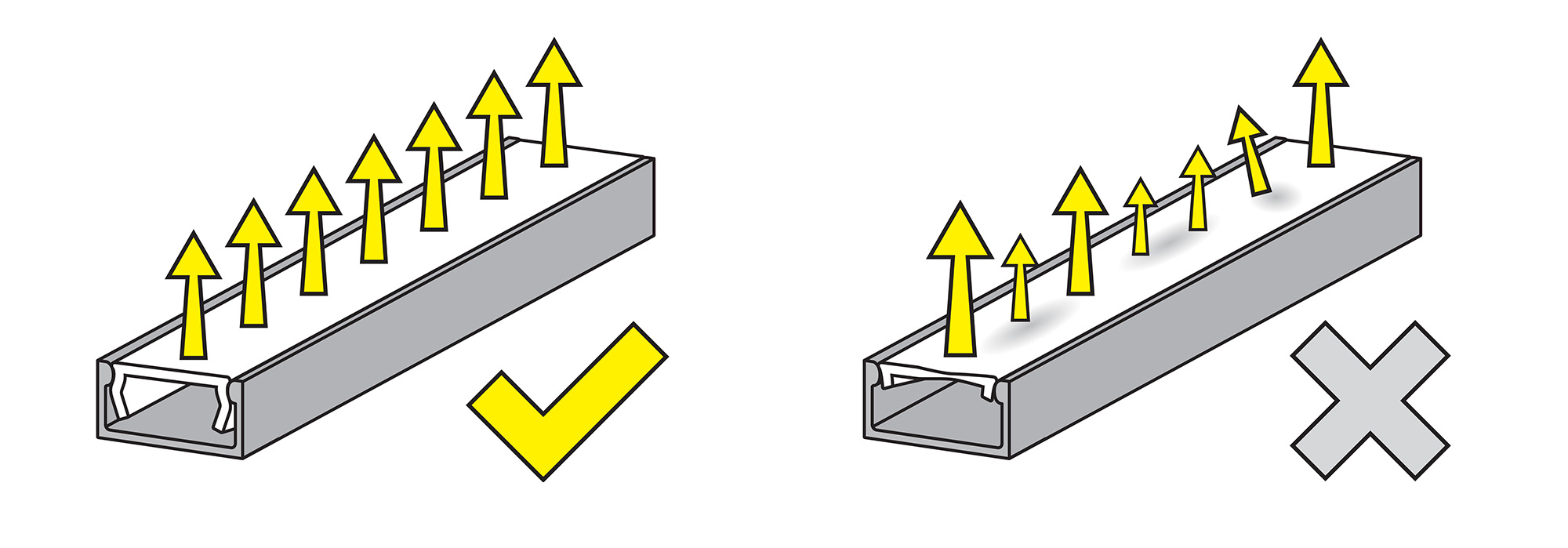
One of the key construction parameters is wall thickness and its uniformity. This affects both mechanical strength and the way the material behaves under varying temperature conditions.
Non-uniformities can lead to localised deformations and differences in light transmittance. In practice, this results in disruptions in the perception of the light line, which become particularly visible over longer runs.
Repeatability of production parameters
From a project perspective, what matters is not only how the cover was designed, but also whether its parameters are repeatable in production.
Differences between batches can affect the fit to the profile and the light effect, even when nominally dealing with the same product. Lack of tolerance control leads to loss of predictability both at the design stage and during installation.
Lack of material uniformity can additionally lead to differences in the light effect and increased susceptibility of the cover to mechanical damage.
Surface structure and light perception
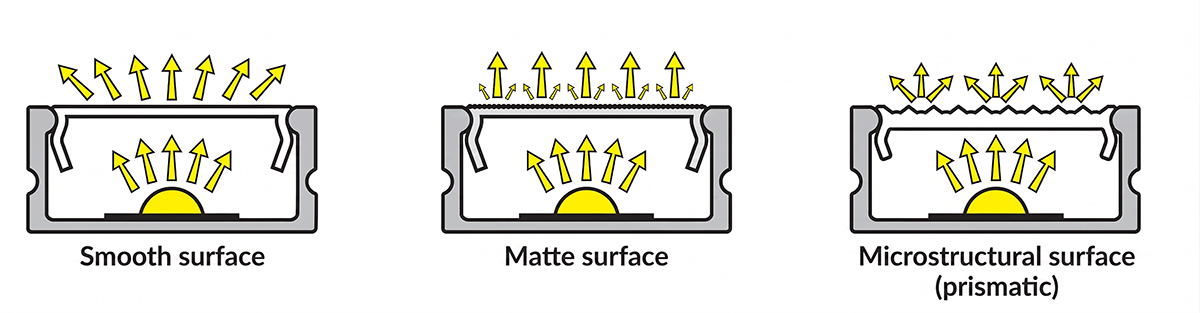
Light perception is influenced not only by the material and colour of the cover, but also by the structure of its surface. Even with the same material parameters, a change in finish can significantly affect the way light is distributed.
A smooth, matte, or microstructural surface will diffuse light differently, which directly affects the uniformity of the light line and its visual appearance.
It should be noted that even when using the same material, differences in its parameters can result in a different surface structure and, consequently, a different perception of light.
Behaviour over time and operating conditions
An LED cover operates in an environment subject to temperature changes and cyclic loads. In such conditions, it is important how the material and construction respond to thermal expansion and long-term use.
An important, and often overlooked, aspect is the elasticity of the material and its ability to return to its original shape after deformation. In practice, this means whether the cover, after installation and repeated use, retains its clamping force or gradually loses it.
A material with insufficient elasticity may undergo permanent deformation over time, leading to a weakened connection with the profile, development of play, and deterioration of the overall system stability. Appropriately selected elastic properties, on the other hand, allow the repeatable seating of the cover to be maintained and predictable performance over a long service life.
At the beginning of use, differences between solutions may not be visible. Only over time does it become apparent whether the cover retains its properties, or whether changes in fit, stability, and light quality occur.
Details invisible at the installation stage
In many cases, construction differences are not visible during installation. Covers may look identical and appear to be correctly fitted.
The real differences only emerge during use, particularly in longer installations or those operating in demanding conditions. This is when it becomes apparent whether the construction was designed with all the relevant parameters in mind.
Summary
At the specification level, an LED cover is most commonly described by its material and type. In practice, its actual performance is determined by the material, the type of cover, and the construction details.
Key factors include:
-
- edge geometry and seating method (click),
- wall thickness and uniformity,
- repeatability of production parameters,
- surface structure,
- elastic properties of the material.
These elements, combined with an appropriately selected LED strip, influence the stability of the system, the quality of light, and the durability of the entire installation.
Differences between solutions may be visible at the installation stage, but most often they emerge during use. It is at this level that it is decided whether the system will perform in accordance with the design assumptions over a long period of use.


