
Why fit and geometry determine the durability of the lighting system
In linear LED lighting, the starting point is always the lighting effect: a uniform line of light, no visible LED points, glare control, and repeatability across the entire installation.
To achieve this effect, the profile, light source and diffuser are selected.
In practice, however, even correctly selected components do not always guarantee the expected result.
Differences become visible both at the installation stage and during operation and result from a combination of two factors: material properties and the mutual fit of system components.
It is this compatibility that determines the stability, durability and predictability of the entire installation.
Fit vs actual system performance
In design practice, it is often assumed that the diffuser and the profile “should fit”. This assumption is not sufficient.
What matters is not the possibility of installation itself, but the quality of geometric fit.
The diffuser may:
-
- be loose relative to the profile,
- require excessive force during installation,
- not adhere evenly along its entire length.
At the installation stage, this is not always clearly visible.
Problems appear during operation, when the system is exposed to temperature changes and cyclic loads.
Impact of fit on the lighting effect
Imprecise fit of the diffuser to the profile directly affects the final result.
It may cause:
-
- gaps and light leakage to the sides,
- an uneven line of light,
- local differences in light diffusion,
- deterioration of the visual quality of the installation.
In linear systems, even small geometric deviations can be visible along the entire length of the fixture.
Diffuser geometry and light distribution
The shape of the diffuser directly affects how light spreads in space.
Depending on the geometry (e.g. flat, semi-round, angular, lens-shaped), it influences:
-
- how the light spreads in space,
- the level of its diffusion,
- the visual effect of the light line.
Geometry also affects how the diffuser is seated in the profile and the nature of the mechanical connection, and therefore the stability of the system over time.

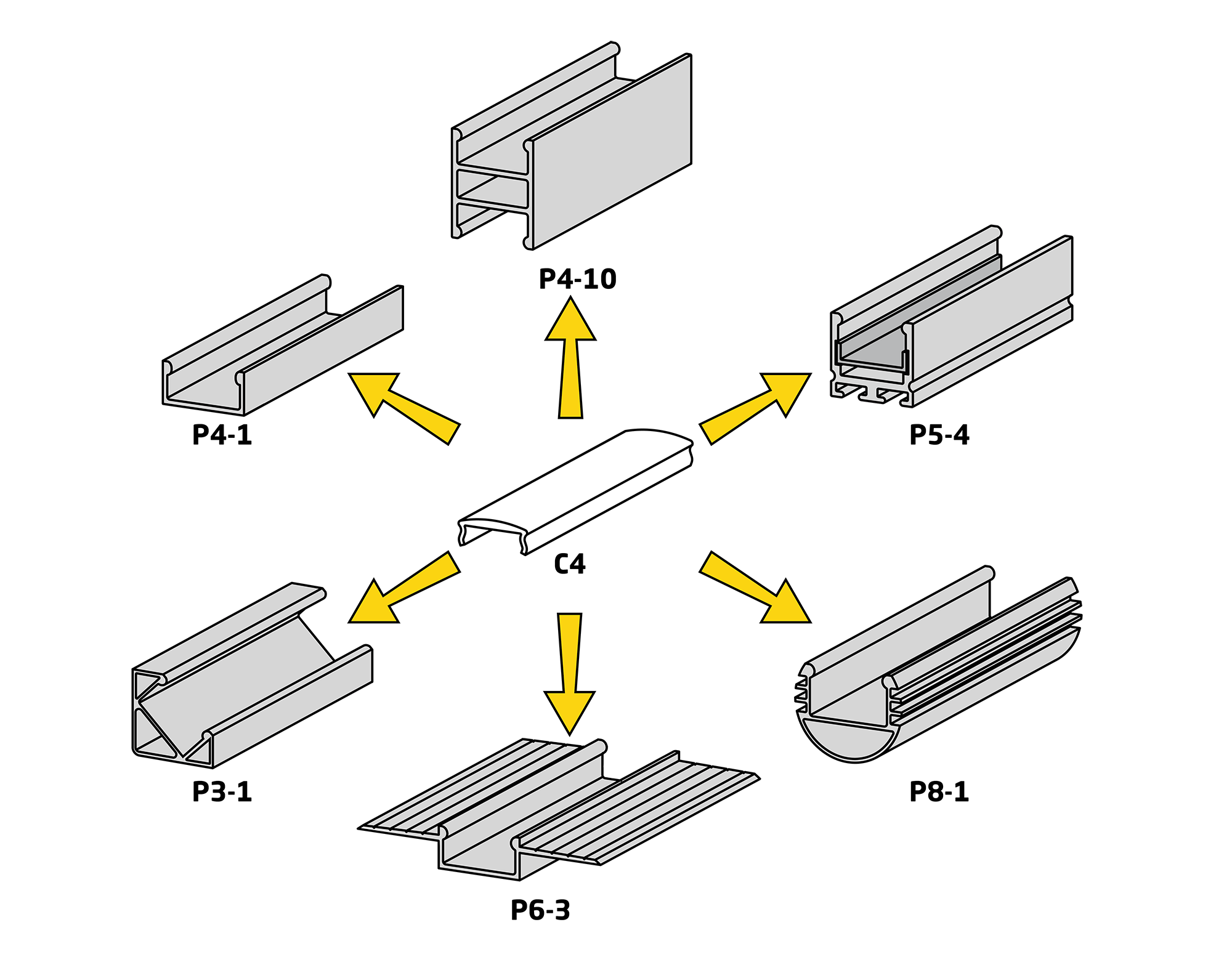
One diffuser – multiple profiles
In some professional linear lighting systems, solutions are used where one diffuser is compatible with multiple profiles.
This is not a standard market approach, but the result of deliberate system design.
Such compatibility requires:
-
- consistent dimensional assumptions,
- repeatable installation method,
- controlled production tolerances.
This allows:
-
- stable installation of the diffuser in different profiles,
- maintaining a consistent lighting effect,
- achieving different lighting effects within the same system.
This is a design solution that enhances system flexibility without compromising its performance.
Mounting mechanics and system stability
The way the diffuser connects to the profile directly affects the durability of the system.
Precise fit:
-
- ensures stable positioning of the diffuser,
- eliminates gaps,
- allows repeatable installation and removal,
- maintains a consistent lighting effect.
Lack of control in this area may lead to:
-
- gaps at the interface,
- local deformations,
- instability during use,
- deterioration of light quality.
Sealing and applications requiring increased resistance
In some applications, not only the lighting effect matters, but also resistance to environmental factors.
This applies to installations:
-
- in high-humidity environments,
- in areas exposed to dust or dirt,
- in industrial or outdoor applications.
In such cases, so-called hermetic solutions are used.
However, sealing is not a feature of a single component, but the result of the entire system.
It depends on:
-
- the fit between diffuser and profile,
- the way components are connected,
- the quality of installation.
Summary
Compatibility of the diffuser with the LED profile is not simply a matter of whether the elements can be connected.
Key factors include:
-
- geometric fit,
- mounting method,
- long-term stability,
- and impact on the lighting effect.
Differences between solutions may be visible already at the installation stage and become more apparent during operation.
In professional systems, compatibility also means the ability to use different diffusers within the same profile to achieve different lighting effects.
Therefore, compatibility should be treated as one of the fundamental design parameters in linear LED lighting systems.
The next article will discuss the structural details of covers, which have a direct impact on their durability and quality of performance over a long period of use.


