
How to choose the right one and why it is a technical, not exclusively aesthetic decision
In previous articles, we showed that the choice of LED cover material has a direct impact on the durability and predictability of the lighting system.
This time, we go one step further.
Even the best material does not solve everything if the type of cover is not properly selected for the project and LED profile.
A cover is not just a closing element of the profile.
To komponent, który:
-
-
- shapes light diffusion,
- affects glare level (UGR),
- determines the visibility of LED points,
- changes the effective amount of light reaching the space,
- works mechanically with the profile.
-
In practice, this is a design decision.
Basic types of LED profile covers
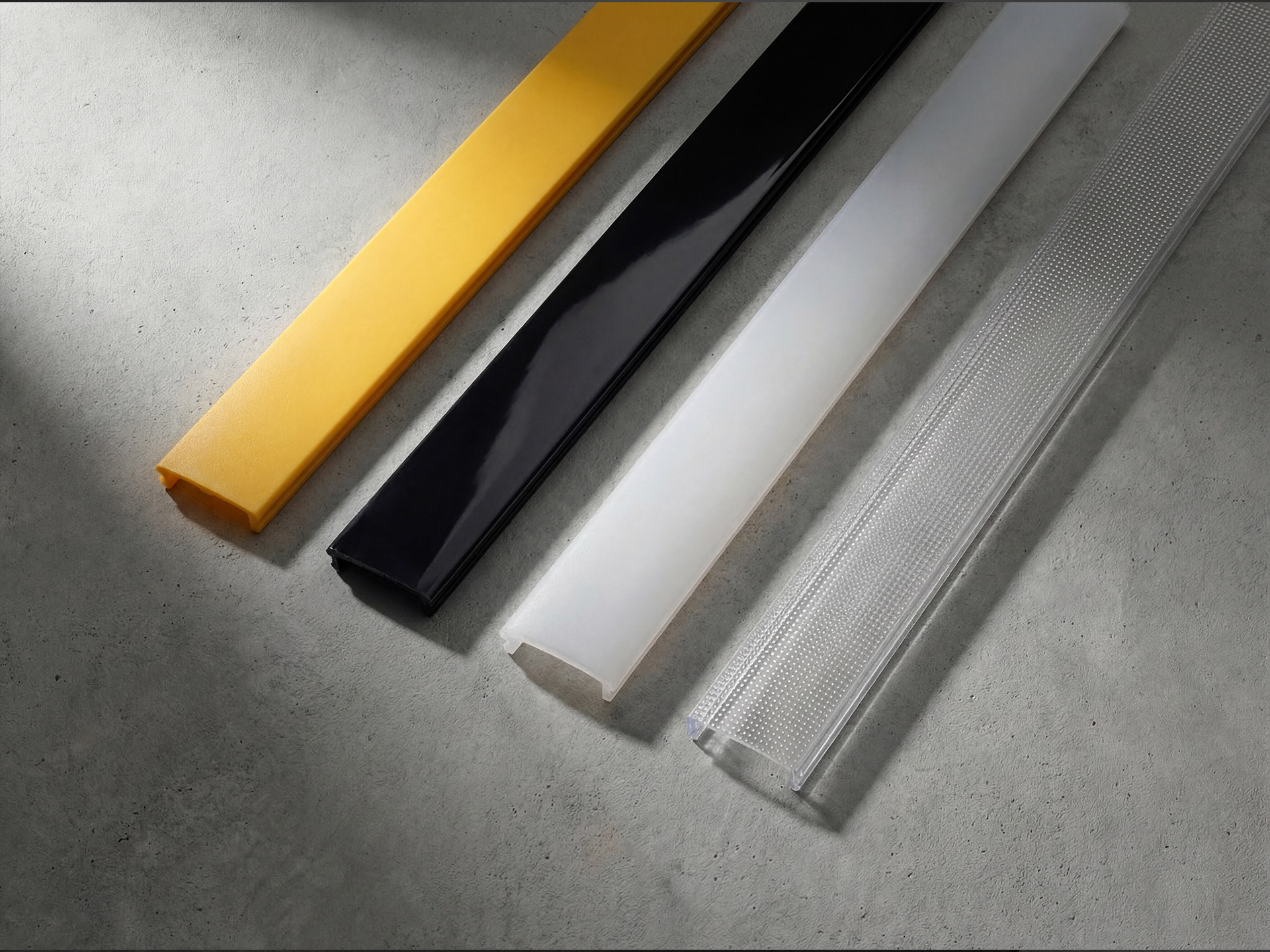
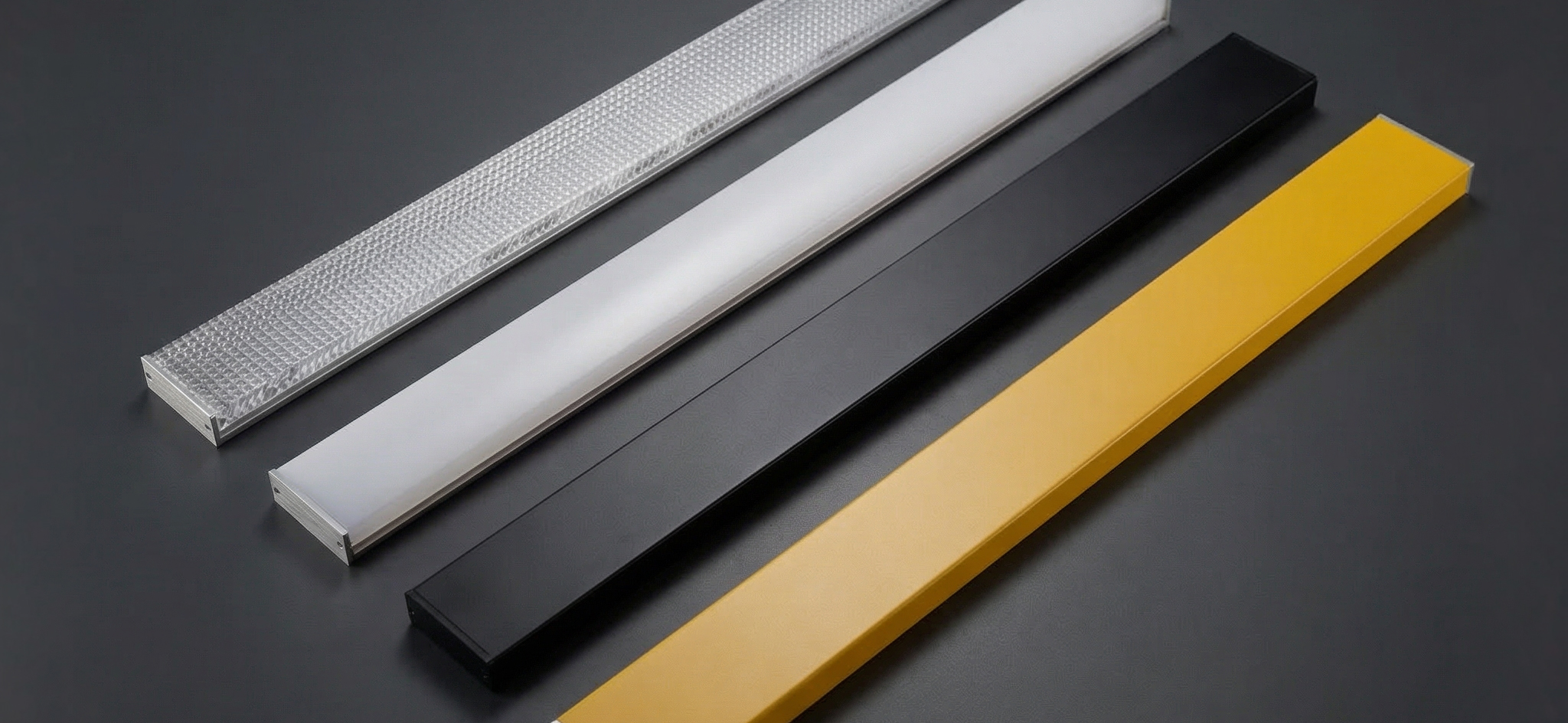
There are several main types of covers available on the market, differing not only in appearance but primarily in function.
1. Transparent covers
Characteristics:
-
-
- high light transmission,
- minimal diffusion,
- clearly visible LED points.
-
Applications:
-
-
- technical installations,
- functional lighting,
- applications where maximum light efficiency is required.
-
Design implication:
A transparent cover provides the highest luminous output but does not hide the LED strip structure.
2. Milky / opal / black & white covers
Charakterystyka:
-
-
- moderate light transmission,
- noticeable diffusion,
- reduced visibility of LED points,
- uniform light line.
-
Applications:
-
-
- residential interiors,
- commercial spaces,
- projects where visual continuity of light is essential.
-
Design implication:
Milky / opal / black & white covers reduce the effective luminous flux but significantly improve visual comfort.
Different color variants are also available, which affect the visual appearance of the system; however, their selection is primarily aesthetic rather than functional.
Prismatic and lens covers
Characteristics:
-
-
- control of light emission direction,
- glare reduction,
- influence on UGR parameter,
- partial light guidance.
-
Depending on the design, they may have a prismatic or lens structure, affecting how light is distributed in space.
Applications:
-
-
- offices,
- workspaces,
- public buildings.
-
Design implication:
These are functional solutions aimed at improving visual comfort and lighting quality.
Technical (installation) covers
Characteristics:
-
-
- designed for installation and finishing works,
- resistant to repeated assembly and disassembly,
- used temporarily during project execution
-
Zastosowanie:
-
-
- protecting profiles during works (e.g. plastering, painting),
- installation stage.
-
Design implication:
Technical covers are not part of the final lighting system, but they play an important role in protecting components and ensuring installation quality.
Light transmission and final effect
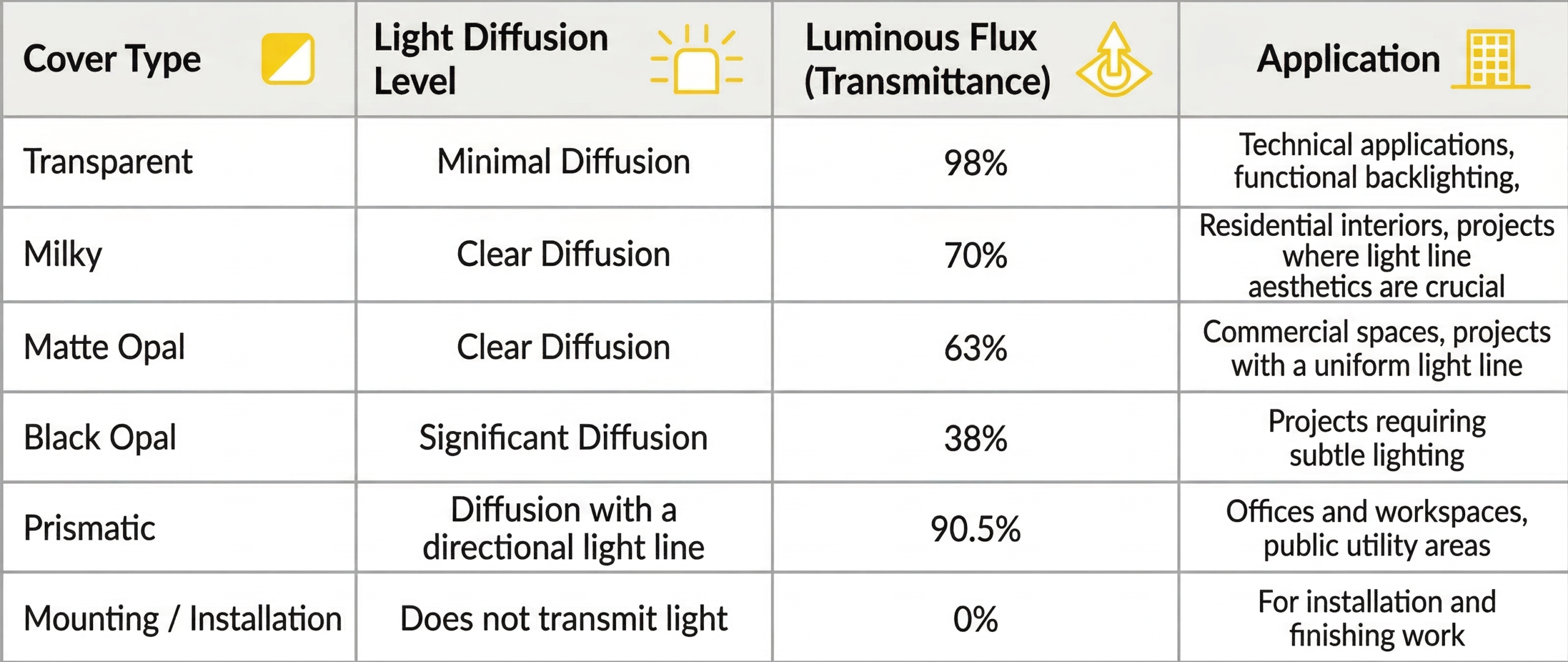
Each type of cover affects the amount of light reaching the space.
Indicatively:
-
-
- transparent: highest transmission,
- milky: medium,
- opal: moderate,
- prismatic / lens: design-dependent,
- black and colored: lower transmission.
-
These differences directly affect:
-
-
- system efficiency,
- LED strip power requirements,
- lighting balance in the project.
-
LED point visibility vs profile depth
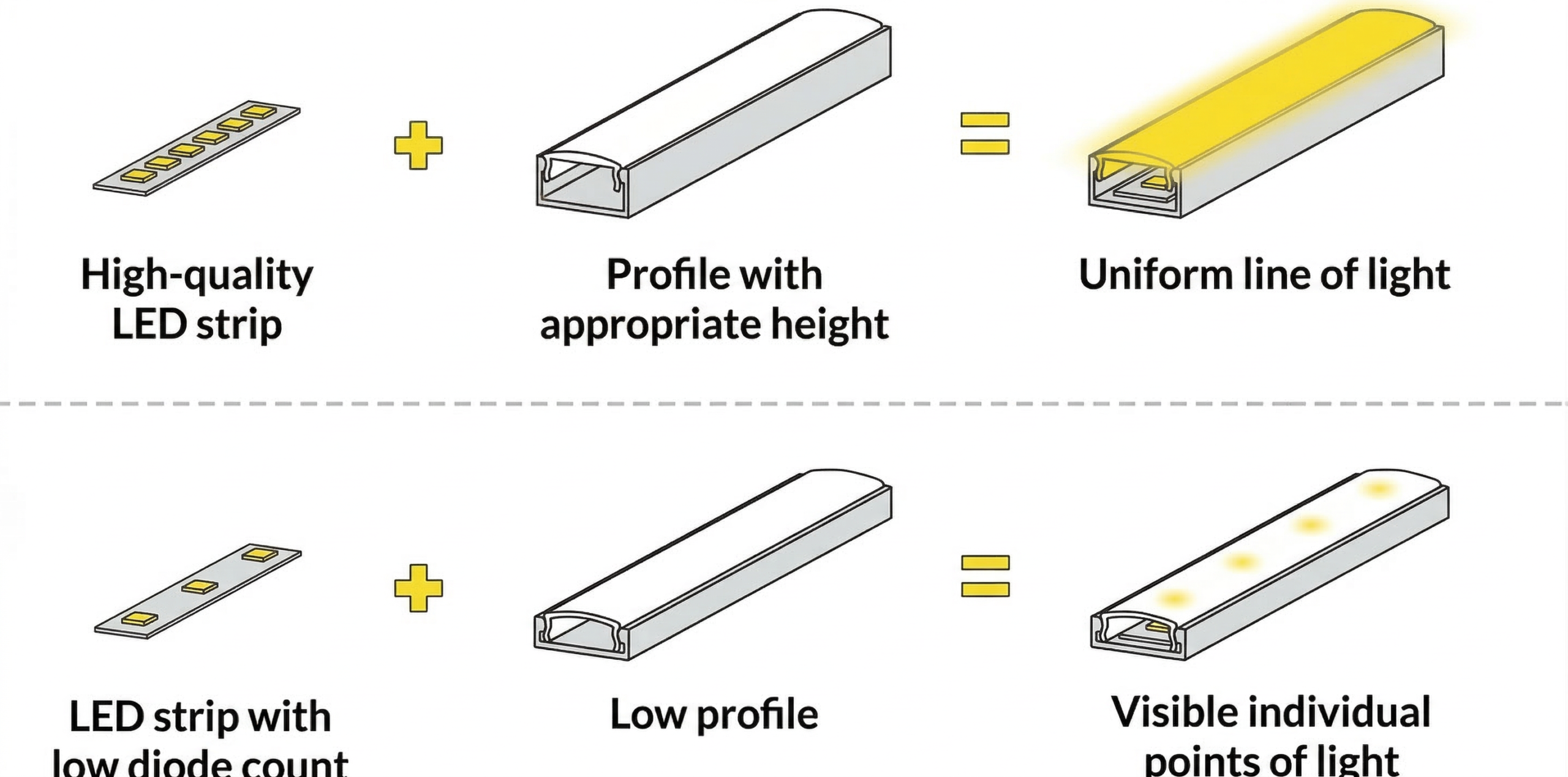
One of the most common design mistakes is selecting a cover without considering:
-
-
- LED spacing on the strip,
- profile depth,
- type of light source.
-
A milky cover may not provide a uniform light line if:
-
-
- the profile is too shallow,
- LEDs are spaced too far apart.
-
In practice, this means that the cover type must always be considered together with the profile and light source.
Compatibility with the profile – more than just “fit”
A cover is not a universal component.
Differences in width, thickness, and mounting system affect:
-
-
- stability after installation,
- tightness,
- vibration resistance,
- long-term durability,
- possibility of repeated assembly and disassembly without loss of properties,
- uniform light diffusion at the profile–cover interface.
-
In a system-based approach, the cover and profile form one structural unit.
This topic will be developed further in the next article.
Sealing and applications requiring increased resistance
In some lighting projects, not only light diffusion matters, but also the system’s resistance to external factors such as moisture or contamination.
This applies, among others, to installations:
-
-
- in areas with increased humidity,
- in environments exposed to dust or particles,
- in industrial or outdoor applications.
-
In such cases, so-called hermetic solutions are used.
In practice, it is important to remember that the level of sealing depends on the entire system — including how the cover fits the profile and how it is installed.
Proper installation (e.g. the use of sealants or appropriate mounting materials) is just as important as the selection of components
Cover selection as a design decision
The choice of cover type should consider:
-
-
- type of space (office, residential, public),
- visual comfort requirements,
- expected visual effect,
- LED strip parameters,
- profile geometry.
-
Only by combining these factors can the right decision be made.
Summary
The type of LED cover is not uniquely an aesthetic detail.
It is an element that affects:
-
-
- system efficiency,
- user comfort,
- long-term performance predictability,
- overall system consistency,
- functional and visual outcome of the installation.
-
Therefore, in professional projects, the question should not only be:
“is it polycarbonate?”
but also:
“which type of cover best fits the working conditions and the intended effect?”
In the next article, we will take a closer look at compatibility between covers and LED profiles, and why a system-based approach is crucial for long-term durability.


