
Why Polycarbonate and Its Quality Are Crucial in Professional LED Systems
LED profile covers are one of the key components of linear lighting systems, although they often remain overshadowed by the profiles and light sources themselves. In practice, however, they largely determine visual comfort, installation durability, user safety, and the long-term stability of lighting parameters.
Differences between cover materials are rarely visible on the day of installation. They usually become apparent only after months or years of operation, when the installation is exposed to elevated temperatures, repeated heating and cooling cycles, and UV radiation.
In this article, we examine the materials used in the production of LED profile covers and explain why polycarbonate has become the standard structural material in professional LED systems. We also clarify the differences between standard market-grade polycarbonate and the polycarbonate used in TECH Light solutions, which has been specifically selected and optimized for long-term operation in LED systems.
Materials Used in LED Profile Covers
In the production of LED covers, three main groups of materials are most commonly used:
- Polyvinyl chloride (PVC) – a budget material used in simple applications with a short expected service life
- Acrylic (PMMA) – a material with good optical quality but limited mechanical and thermal resistance
- Polycarbonate (PC) – a structural material with high mechanical and thermal resistance
It is important to note that the term “polycarbonate” covers a wide range of materials with varying properties. In practice, standard market-grade polycarbonate and the polycarbonate used in TECH Light covers may differ significantly in performance and long-term behavior.
Comparison of Properties of Materials Used in LED Covers
The table below presents typical properties of PVC and PMMA, indicative parameters of standard market-grade PC (polycarbonate), and material data for PC TL (TECH Light polycarbonate) used in TECH Light covers.
Table 1. Properties of materials used in LED profile covers
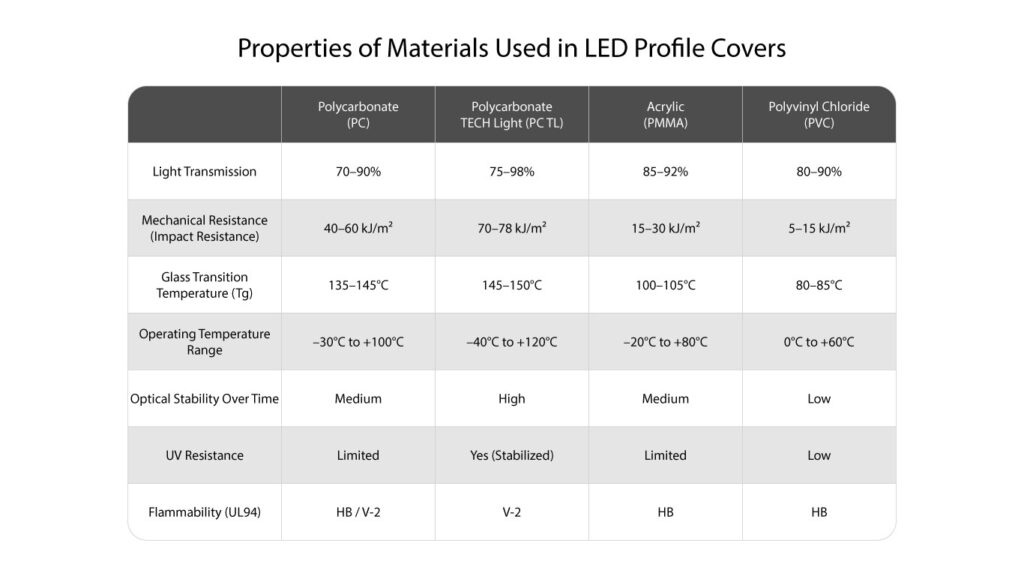
Data for PMMA, PVC, and standard PC are indicative and refer to materials commonly used in LED covers. Actual values may vary depending on the manufacturer and material composition.
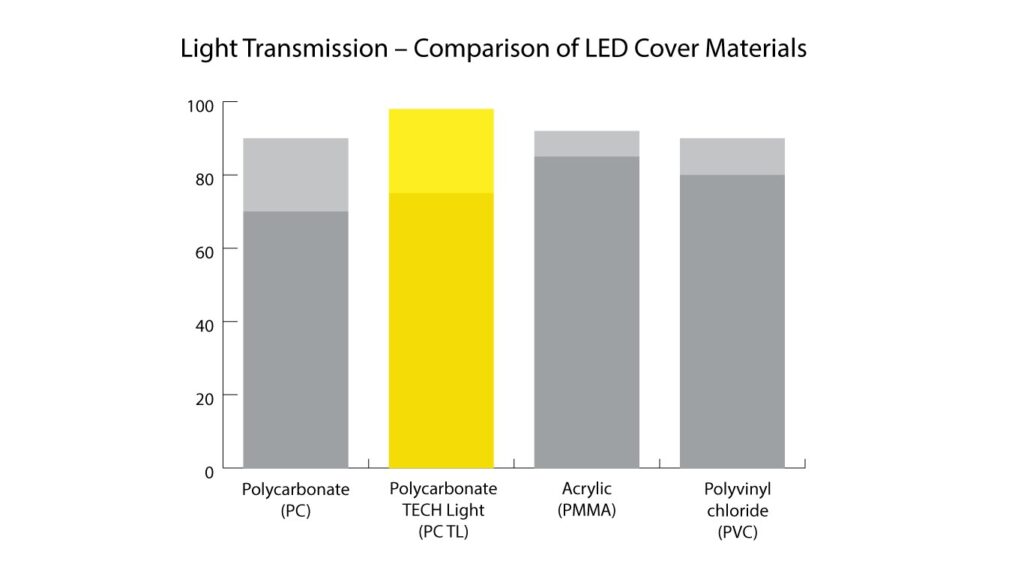
Polycarbonate as a Structural Material in LED Covers
PC (polycarbonate) is a thermoplastic material widely used in the automotive, aerospace, and lighting industries. Its popularity results from a combination of high mechanical strength, thermal stability, and good optical properties.
Compared to PVC and PMMA, polycarbonate:
- maintains elasticity over a wide temperature range,
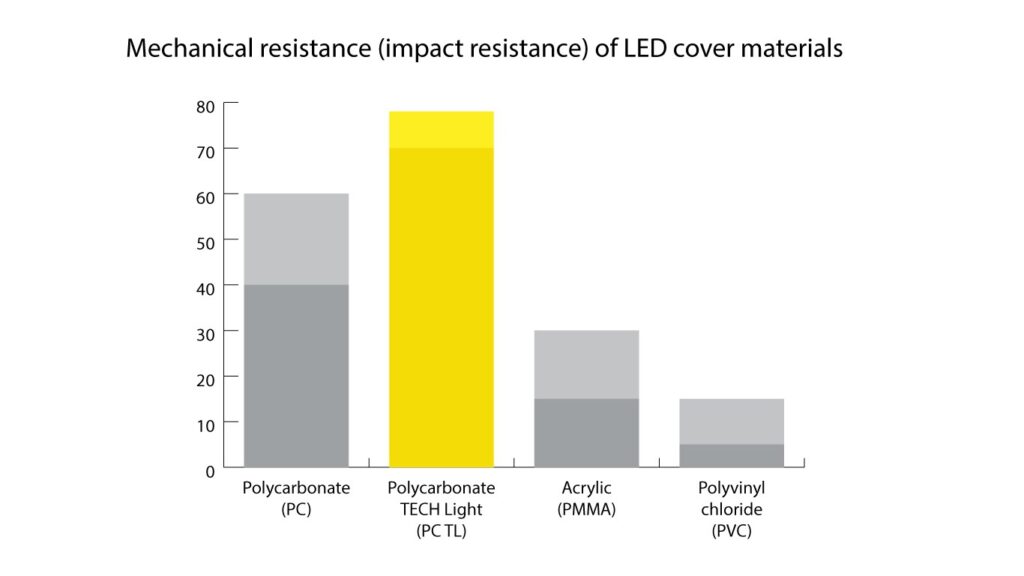
- is significantly more resistant to cracking and mechanical damage,
- better withstands long-term operation in elevated temperatures,
- can be stabilized for UV resistance.
At the same time, not every polycarbonate delivers the same final performance in LED covers. Material formulation, stabilizing additives, and production process control have a direct impact on long-term material behavior.

Standard Polycarbonate vs. TECH Light Polycarbonate – Where Is the Difference?
Standard market-grade polycarbonate provides a solid material base for LED covers; however, in many cases, its parameters represent a compromise between cost and performance.
In TECH Light solutions, we use exclusively polycarbonate that is:
- selected specifically for long-term operation in LED systems,
- stabilized for resistance to UV radiation,
- processed under controlled manufacturing conditions,
- designed with optimized wall thickness and material homogeneity.
As a result, TECH Light covers retain their mechanical and optical properties over a significantly longer period of use compared to solutions based on standard PC blends.
Why Material Differences Become Apparent Over Time
On the day of installation, covers made from different materials may appear very similar. Differences emerge only during operation, when the material is exposed to:
- heat generated by LED strips,
- repeated heating and cooling cycles,
- UV radiation,
- mechanical stresses.
Materials with lower resistance may lose elasticity over time, crack, or change their optical properties. High-quality polycarbonate, properly selected and stabilized, maintains its parameters far more effectively over long-term use.
Summary
The choice of material for an LED profile cover is a technical decision that directly affects the durability, safety, and predictability of the entire lighting system. PVC and PMMA may be suitable for simple applications; however, for installations designed for many years of operation, polycarbonate remains the most stable base material.
At the same time, not every polycarbonate produces the same result. Differences in formulation, UV stabilization, thickness, and production process control mean that covers may behave very differently over time.
For this reason, in professional LED systems, TECH Light polycarbonate is not treated as a novelty or trend, but as an advanced development of the base material—designed for real operating conditions and long-term reliability.


